
Audio & Headphones · Buying guide
Most running earbuds do not fail because they sound bad. They fail at kilometre three, when the left one works loose, you push it back with a damp finger, and it drops out again twenty strides later. The sound was never the problem. Retention is.
If you run a regular route — a canal towpath, a park loop, the same pavement circuit after work — the constraints are specific and they are not about audio quality. Your head moves. You sweat. Your ear canal shifts shape slightly as your heart rate climbs. An earbud that felt solid while you stood at the kitchen counter is a different object after twenty minutes of running.
This is a guide to that gap, and to the honest limits of the category.
Fit and retention decide everything
The most useful thing you can do before buying is work out what kind of fit your ears accept. There are broadly two designs:
- Winged or finned earbuds use a soft protrusion that presses against the ridge of your outer ear. The wing does not enter the canal; it braces against the bowl of the ear to stop rotation. This suits ears with a pronounced ridge and a fairly average canal.
- Wing-free earbuds rely entirely on the tip and the shape of the housing. They feel less obtrusive and suit people whose ears reject pressure from a fin, but they leave less margin for error if your canal sits between two tip sizes.
Neither is better in the abstract. The mistake is buying a winged design because the marketing calls it “secure” when your ears have never tolerated fins.
Rule of thumb. If an earbud has to be pushed back into place more than once in the first ten minutes of walking, no amount of running-specific marketing will fix it. Fit problems get worse with sweat, not better.
Sweat and rain: what the ratings actually mean
Water and dust ratings are expressed as an IP number, and the second digit is the one that matters here. The first digit covers dust and the second covers water, and a higher second number means more resistance. The important caveat is that these ratings are tested in fresh water under laboratory conditions. Sweat is salty and slightly corrosive, and a long run in heavy rain is a harder test than the standard implies.
For running, look for a rating that explicitly covers sweat and rain rather than a splash rating meant for a walk to the car. The Jabra Elite 8 Active, based on published specifications, is rated for exactly this kind of use, including a ruggedised case that survives being thrown into a gym bag. That durability is the feature you are buying, not the sound.
Hearing traffic is a safety decision
If you run on roads, on paths shared with cars, or anywhere you cross traffic, awareness matters more than isolation. There are two ways to get it:
- Transparency mode pipes the outside world through the earbud microphones. It works well, and it is the reason a good pair of noise-cancelling earbuds can still be a road-running option. The Apple AirPods Pro 2 is the reference here for how natural its transparency mode sounds.
- Open-ear designs never block the canal at all. You hear everything, at the cost of bass and of any isolation on a noisy train afterwards.
The mistake is treating noise cancelling as a running feature. Active noise cancelling is genuinely useful on a train or a plane. On a road it is a hazard, and you should plan to run with it switched off.
Bone conduction is a different category
Bone conduction headphones, like the Shokz OpenRun Pro 2, do not sit in your ear at all. They rest on your cheekbones and send vibration through the bone to your inner ear. The consequence, based on published specifications, is that bass is physically limited by the format: you cannot move as much air through bone as through a driver sitting in your ear.
What you buy instead is situational awareness that no transparency mode quite matches, because nothing is in the canal to begin with. For urban cycling and road running, that trade is usually worth it. For anything else — a noisy gym, a train, a flight — bone conduction is close to useless, because it does not block outside sound and it leaks your own audio outward.
Our picks
Three models for three different running realities. Each entry says what the recommendation rests on and, more importantly, what you give up.
Jabra Elite 8 Active — for sweat and weather. If your priority is an earbud that survives repeated sweaty sessions and rain without drama, this is the one to shortlist. The fit is designed to hold without aggressive wings, and the case is ruggedised, which matters more than it sounds when it lives in a bag. You give up some refinement: the sound is tuned for energy rather than accuracy, and the noise cancelling is a step behind the class leaders.
Apple AirPods Pro 2 — for iPhone owners who want one earbud for everything. The fit is tip-based with no wings, so retention depends on choosing the right tip size, and you should not skip the ear-tip fit test in the settings. What you get is the smoothest device switching in the category and the most natural transparency mode, which makes it a safe choice for road running where you need to hear cars. Android owners should look elsewhere, because support outside Apple’s ecosystem is basic.
Shokz OpenRun Pro 2 — for cyclists and road runners who need their ears open. If awareness is the whole point, this is the honest answer. Nothing enters the canal, so you hear traffic, bells and other people. The trade is real: bass is limited by the format, it is close to useless in noisy environments, and it leaks sound at high volume.
| What you prioritise | Best fit from this shortlist | What you give up |
|---|---|---|
| Sweat and rain resistance | Jabra Elite 8 Active | Sound accuracy, top-tier ANC |
| Awareness of traffic | Shokz OpenRun Pro 2 | Bass, any isolation |
| One earbud for everything | Apple AirPods Pro 2 | Android support, wing-free retention |
What not to overpay for
- Hi-res codec support. Outdoors, wind and traffic mask far more detail than any codec difference reveals. This is a quiet-room feature.
- Deep active noise cancelling. On a run you will turn it off. Buy it for the commute home, not for the run itself.
- A large battery rating. A published rating is measured under specific conditions, and running sessions are usually shorter than the rating assumes. Match the number to your longest session, not to the biggest number you can find.
- “Sport” branding. A regular earbud with a good tip seal often stays put just as well. The word on the box is not a fit guarantee.
When not to buy anything
If your current earbuds stay in place for the whole run and you only dislike the sound, buying a new pair for running is an expensive way to solve a problem you do not have. Use them, and keep the money.
Equally, if the honest reason you want running earbuds is to distract yourself on a route that is genuinely unsafe — unlit roads, no verge, heavy traffic — no earbud design fixes that. The safest option there is not to listen at all. Buy nothing, and choose a different route.
Where buying does make sense is narrow and specific: your current earbuds fall out, or they die from sweat, or you need to hear traffic and currently cannot. Those are the problems this category actually solves.
Our picks
These are the models we would shortlist for the scenarios in this article. Each entry shows the published specification highlights, what the product is genuinely good at, and what you give up.
Jabra Elite 8 Active
Jabra
Built for people who destroy earbuds. The rubberised shell and IP68-rated case survive sweat, rain and being thrown in a gym bag, and the wing-free fit stays put for most ear shapes.
What it does well
- Survives sweat and rain without drama
- Secure fit without aggressive wings
- Case itself is ruggedised
What to accept
- Sound is tuned for energy rather than accuracy
- ANC is a step behind the class leaders
- Not the most comfortable for all-day wear
Best for: Running · Gym sessions · Rainy commutes
Published specs: In-ear true wireless with ANC; Dust and water protection rated for workouts; ShakeGrip coating for a stable fit; Published battery rating around 8 hours with ANC off.
Last checked: 2026-09-18
Apple AirPods Pro 2
Apple
The default answer for anyone already inside Apple’s ecosystem. Hand-off between devices is the smoothest in the category, and the transparency mode is still the most natural-sounding of any earbud.
What it does well
- Effortless switching across Apple devices
- Very natural transparency mode
- Compact case that fits a jeans pocket
What to accept
- Android support is limited to basic Bluetooth
- Silicone tips are not for everyone
- Replacement tips are a small recurring cost
Best for: iPhone users · Gym and running · Calls on the move
Published specs: In-ear true wireless with active noise cancelling; Adaptive transparency and conversation awareness; USB-C charging case with speaker and lanyard loop; Published battery rating up to 6 hours per charge.
Last checked: 2026-09-18
Shokz OpenRun Pro 2
Shokz
Bone conduction is a compromise, not a replacement for earbuds. What it buys you is situational awareness — you hear cars, bells and colleagues while still hearing your audio. For urban cycling that trade is usually worth it.
What it does well
- You keep full awareness of your surroundings
- Comfortable with glasses and helmets
- Nothing enters the ear canal
What to accept
- Bass is physically limited by the format
- Useless on a plane or a noisy train
- Sound leaks at high volume
Best for: Cycling · Road running · Office conversations
Published specs: Bone conduction, open-ear design; Sweat-resistant build for training; Dual-driver setup with improved bass over earlier models; Published battery rating around 12 hours.
Last checked: 2026-09-18
Frequently asked questions
Do I need sweat-proof earbuds for running?
If you sweat heavily or run in rain, yes. Sweat is salty and slightly corrosive, and a rating that covers sweat and rain will last longer than a splash-only design. The rating matters most for the case, which sits damp in a bag between runs.
Are wing tips better for running?
Only if your ears tolerate them. Wings brace against the ridge of the outer ear to stop the earbud rotating, which helps some ear shapes and irritates others. If a fin presses uncomfortably, a wing-free design with the correct tip size can be just as stable.
Can I run with noise-cancelling earbuds?
You can, but you should run with the cancellation switched off. Active noise cancelling is designed for steady noise like engines and ventilation, and on a road it removes the sound of approaching traffic, which is a safety problem. Use transparency mode instead if you want to stay aware.
Are bone conduction headphones better for running?
For road running and cycling they can be, because they leave your ear canal open so you hear everything around you. The cost is limited bass and no isolation at all, which makes them a poor choice on a train or in a gym. They suit safety and awareness, not sound quality.
Related

Audio
Best Noise-Cancelling Headphones for Open-Plan Offices
Open-plan offices are the hardest listening environment there is. Here is how to choose noise-cancelling headphones for a shared desk, and which models we would shortlist.
Audio
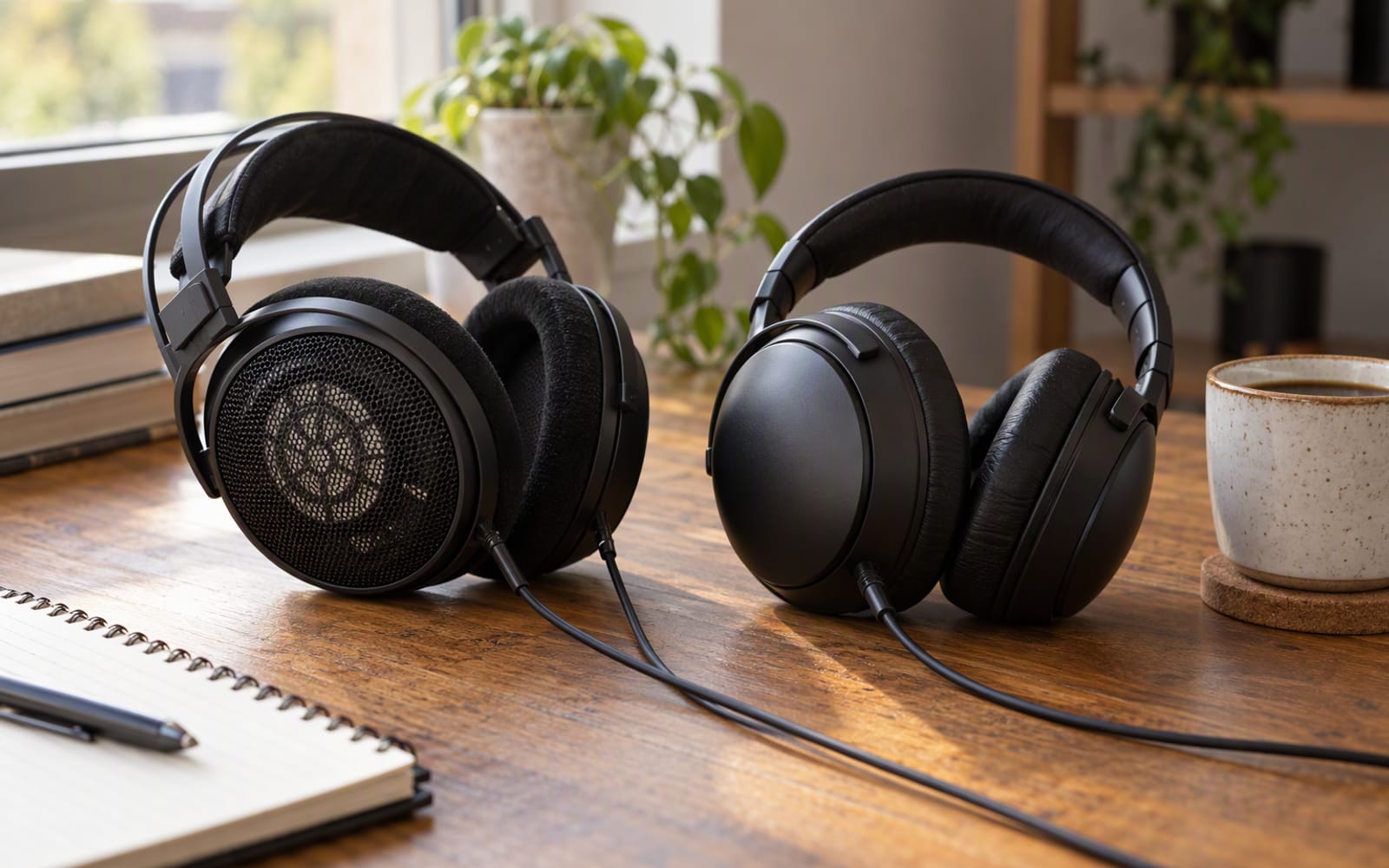
Open-Back vs Closed-Back Headphones: Which Should You Buy?
The single biggest decision in headphone buying is not the brand or the price. It is whether the cups are open or closed. Here is how the choice changes everything.

Audio
Best Budget Wireless Earbuds Under $100 for Commuters
What you actually give up on budget commuter earbuds — wind-hit microphones, plain apps, shallow ANC — and why that trade is usually the right one.