
Phones & Mobile · Buying guide
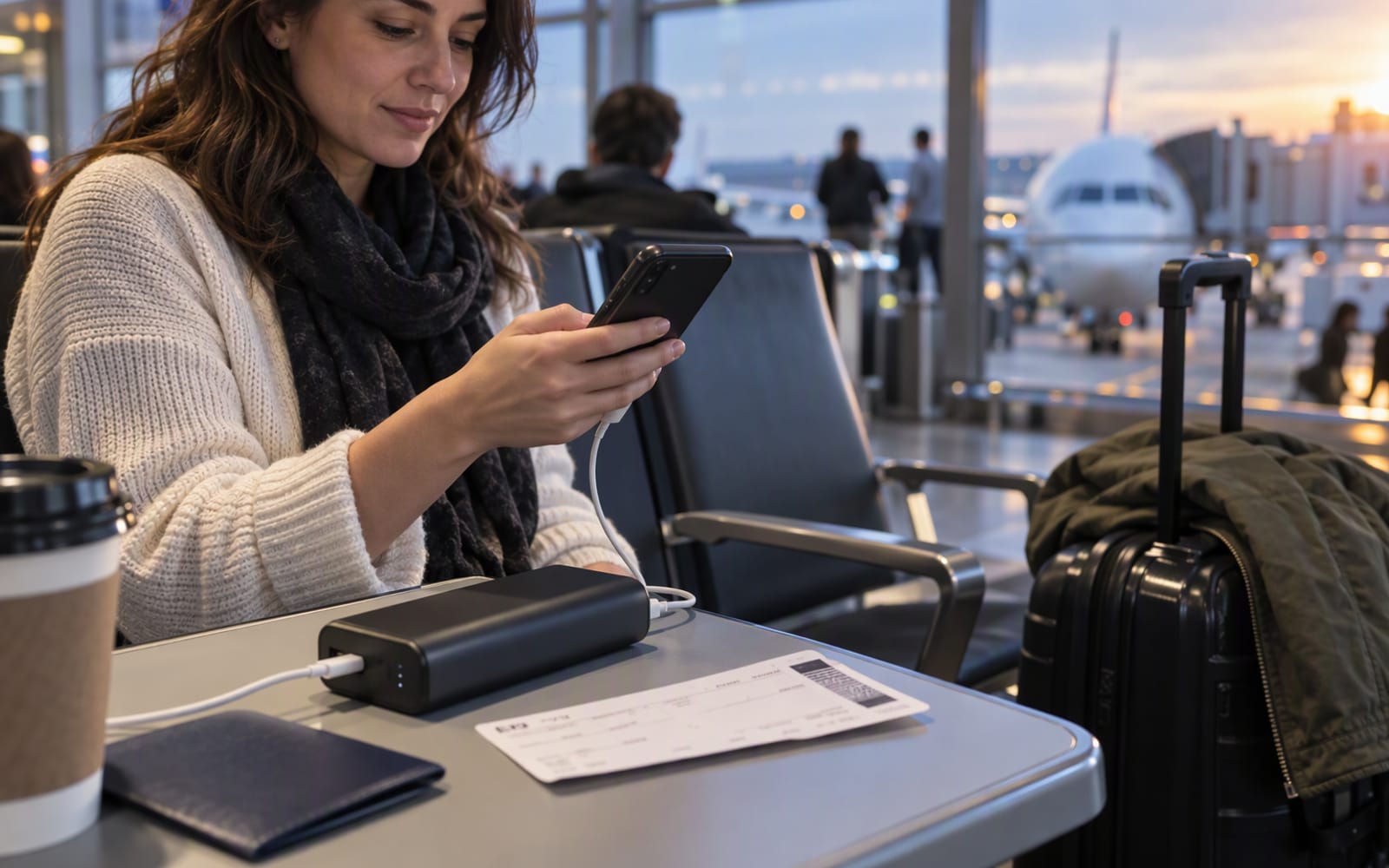
You board a long-haul flight with a laptop you need for work and a phone you need at the other end. The seat has a socket, but it is shared, intermittent, or the person next to you has already claimed it. By hour six the phone is in the red and the laptop is not much better.
The mistake people make is buying the biggest bank they can find. The right choice depends on three questions: what you are charging, whether the airline lets you carry it, and how you will recharge the bank itself.
The airline rule you have to check
Airlines restrict lithium batteries by watt-hour rating, not by milliamp-hour capacity. The commonly cited threshold is 100 Wh per battery for carry-on without special approval, with anything above that needing the airline’s permission and often refused. Many carriers also cap the number of spare batteries you can bring.
Watt-hours and milliamp-hours are not the same number, which is where people get caught out. A power bank’s mAh rating is only half the story; the voltage matters too. The number the airline cares about is the Wh figure printed on the pack, and it is usually printed there for exactly this reason.
Two rules follow from that:
- Power banks go in carry-on, never checked luggage. This is near-universal across carriers.
- Check your specific airline before you buy. Limits, approvals and the number of spares vary, and they change. A pack that sails through one carrier’s gate may be questioned by another.
Rule of thumb. If the watt-hour figure is not printed on the shell, treat that as a reason to look elsewhere. You may be asked to show it at security, and “I am not sure” is not an answer that helps you.
Laptop charging versus phone top-ups
The second question is what you actually need to charge. A phone top-up and a laptop recharge are very different jobs, and buying for the second when you need the first is how you end up carrying dead weight.
- Phone only. You need a modest capacity and a USB-C PD output that matches your phone. This is the lightest and cheapest category.
- Phone plus tablet. Mid capacity, and enough output to charge both without slowing to a crawl.
- Laptop. This is where the serious packs live. A thin laptop needs a sustained output high enough to charge while it is in use, and a capacity large enough to matter. This is also where the weight and the airline limits become real.
If you are not charging a laptop, most of the premium in this category is wasted on you.
Recharging the bank itself
This is the part buyers forget. A high-capacity pack takes a long time to refill, and how long depends entirely on the wall charger you plug it into. A pack that supports fast input but is paired with a slow charger will take an overnight session to refill, which is a problem on a trip with back-to-back travel days.
The practical advice is to buy the wall charger alongside the bank, not later. Several of these packs only reach their rated recharge speed with a high-wattage charger that is a separate purchase. Budget for both.
Weight in a bag
Capacity and weight travel together. The packs that can genuinely charge a laptop are heavy enough that you feel them in a shoulder bag by the end of a travel day. That is the trade: more capacity, more weight, and a harder look from the airline’s watt-hour rule.
If the bank lives in a carry-on and comes out on the plane, weight matters less. If you are carrying it around a city all day, the lighter pack is worth the smaller capacity.
Our picks compared
| Anker 737 Power Bank | Anker Prime Power Bank | UGREEN Nexode Power Bank 145W | |
|---|---|---|---|
| Published capacity | Around 24,000 mAh | Around 20,000 mAh | Around 25,000 mAh |
| Best for | Laptop charging on long flights | Fast laptop charging in a small body | Value laptop-class charging |
| Display | Charge and wattage display | Charge display | Charge display |
| Weight | Heavy | Pocketable for its class | Heavier than premium rivals |
| Main trade-off | Near the limit of some airline rules | Best speed needs a separate charger | Finish marks easily |
Editorial note. These are published capacities, not measured ones. Techowire does not run a test lab. The figures come from the manufacturers’ specifications and are quoted so you can compare like with like, not as a claim about real-world performance.
The three picks in context
The Anker 737 Power Bank is the one to shortlist if the job is charging a laptop on a long flight. Its published capacity is close to the limit some airlines allow in carry-on, so check the rules for your carrier before buying it for a specific trip. It is heavy, and it recharges slowly without a high-wattage charger, but the display removes the guesswork about what is left.
The Anker Prime Power Bank trades some capacity for sustained output in a body that still fits a jacket pocket, which suits remote work, airport layovers and cafés without a socket. Its catch is the same as the others: it performs at its best only with a matching high-wattage wall charger, which is an extra purchase. It can also get warm under full load.
The UGREEN Nexode Power Bank 145W undercuts the premium options while still delivering enough wattage for a thin laptop, based on published specifications of around 145 W total output. Build quality is a small step below the leaders, it is heavier than premium rivals, and the finish marks easily, but for the money it covers the laptop-charging job competently.
What not to overpay for
- Capacity you cannot legally carry. A pack above the carry-on limit is a pack you may have to leave behind.
- A higher wattage than your laptop accepts. Charging a laptop that caps its input lower will not go faster because the bank can do more.
- Wireless charging pads on a power bank. They add bulk and waste energy. Use a cable on a plane.
- A bigger display or app features. The number you need is how much is left, and most packs show that already.
When you should not buy anything
If your flight has working seat power and you are only topping up a phone, a power bank is optional. Many long-haul seats now supply enough to keep a phone alive, and the honest advice is to check your seat and your aircraft before buying.
If you already own a modest pack that covers your phone, the upgrade only makes sense if you have started travelling with a laptop. That is the real trigger for moving up to this category — not a longer flight.
Our picks
These are the models we would shortlist for the scenarios in this article. Each entry shows the published specification highlights, what the product is genuinely good at, and what you give up.
Anker 737 Power Bank
Anker
This is the power bank you take when you need to charge a laptop, not just a phone. The capacity is close to the airline carry-on limit, so check the rules for your carrier before you buy it for a specific trip.
What it does well
- Can charge a laptop, not just a phone
- Display removes the guesswork about remaining charge
- High total output
What to accept
- Heavy — you feel it in a bag
- Near the limit of what some airlines allow
- Recharges slowly without a high-wattage charger
Best for: Long-haul flights · Laptop charging on the move · Festivals
Published specs: High-capacity power bank with USB-C PD output; Published capacity around 24,000 mAh; Digital display showing remaining charge and wattage; Multiple ports for simultaneous charging.
Last checked: 2026-09-22
Anker Prime Power Bank
Anker
High sustained output in a body that still fits a jacket pocket. The catch is that it only performs at its best with a matching high-wattage wall charger, which is an extra purchase.
What it does well
- Sustained high wattage output
- Pocketable for its capability
- Fast to top up with the right charger
What to accept
- Best performance needs a separate charger
- Premium price
- Can get warm under full load
Best for: Remote work · Cafés without sockets · Airport layovers
Published specs: Compact high-output power bank; USB-C PD output suitable for laptops; Published capacity around 20,000 mAh; Charging base compatibility for the brand’s ecosystem.
Last checked: 2026-09-22
UGREEN Nexode Power Bank 145W
UGREEN
Undercuts the premium options while still delivering enough wattage for a thin laptop. Build quality is a small step below the leaders, and the app is optional rather than essential.
What it does well
- Very competitive price for the wattage
- High capacity
- Clear charge display
What to accept
- Heavier than premium rivals
- Finish marks easily
- Fan-less design means it warms up
Best for: Budget laptop charging · Travel · Shared household use
Published specs: High-capacity power bank with 145 W total output; Published capacity around 25,000 mAh; Digital charge display; Multiple USB-C and USB-A ports.
Last checked: 2026-09-22
Frequently asked questions
Can I take a power bank on a plane?
Yes, but as carry-on, not in checked luggage. Lithium batteries are restricted because of fire risk in the hold, and almost every airline requires power banks to travel in the cabin with you. The exact rules vary by carrier and by the capacity of the pack, so check your airline's guidance before you travel rather than assuming one airline's rules apply to all.
How many watt-hours can I carry?
The commonly cited threshold is 100 Wh per battery for carry-on without special approval, with anything above that needing the airline's permission, which is often refused. Many carriers also limit the number of spare batteries. The figure that matters is the watt-hour number printed on the pack, not the milliamp-hour capacity, so look for the Wh rating on the shell.
Can a power bank charge a laptop?
Some can, if they deliver enough sustained output over USB-C Power Delivery and have enough capacity to matter. A thin laptop needs a higher wattage than a phone, and charging it while in use needs more again. If you are only topping up a phone, the extra capability and weight of a laptop-class pack is wasted on you.
How long does a power bank take to recharge itself?
That depends almost entirely on the wall charger you use, not on the pack alone. A high-capacity pack paired with a slow charger can take an overnight session to refill, which is a problem on back-to-back travel days. Several packs only reach their rated recharge speed with a high-wattage charger that is a separate purchase, so budget for both.
Related

Mobile
Best Phone Gimbals for Vlogging on a Budget
A phone gimbal does not make you a filmmaker. Here is what actually matters when buying one for vlogging, and when a small tripod is the smarter buy.
Mobile
Phone Camera Lenses: When an Add-On Lens Actually Helps
Most clip-on phone lenses make your photos worse. Here are the two cases where an add-on lens genuinely adds a capability your phone cannot reach on its own.

Mobile
MagSafe Accessories That Are Actually Worth It
Magnetic accessories are not all gimmicks. Here is which MagSafe batteries, stands and grips solve a real problem, and which ones you can skip.